
Best overall ADHD puzzle in 2026: a 500-piece jigsaw; best for a short hands-on break: a 3x3 twisty cube; best budget format: a paper-and-pencil logic grid. Choose by the time and space you want to give it, not by a promise that one puzzle will calm every brain.
- A 500-piece jigsaw is the best overall ADHD puzzle for a longer, screen-free session in 2026.
- A 3x3 twisty cube is best for a short break with no setup.
- A paper-and-pencil logic grid is the best budget format for portable puzzling.
- Pick a puzzle that fits your setting; none is a treatment or a test of focus.
Why this matters
Sometimes you want your hands occupied without starting another open-ended project. A puzzle offers a defined task: fit the pieces, find the pattern, or solve the grid. You can also put it down. That distinction matters when you are choosing something for a quiet evening rather than another demand on your attention.
There is no single way a neurodivergent person should unwind. One person wants a jigsaw spread across a table; another wants a cube they can turn while waiting for a friend. This 2026 guide compares those choices by what you actually do with them, not by claims about what they will do to your brain. Adhdthreadz sells ADHD-themed apparel, not the puzzle formats ranked here.
What makes the best ADHD puzzle?
- A clear task: You can tell what you are trying to complete, whether that is a picture, a solved cube, or a filled grid.
- The right stopping point: Some puzzles let you stop after one move. Others work better when you can leave them out and return later.
- A fit for your space: A pocket puzzle belongs in a bag; a jigsaw needs a surface you can spare.
- The kind of feedback you like: Turning, fitting, writing, and building feel different. Pick the action you want to repeat.
- Manageable setup: Getting started should suit the time you have, especially if this is meant to be a short break.
- An honest limitation: Every format has a trade-off. A puzzle that stays on a table will not also be the best thing to carry on a commute.
Choose the action first. If you want to turn something, start with a cube. If you want to build a picture, start with a jigsaw. If you want to reason on paper, start with a logic grid. The theme on the box comes after that decision.
ADHD puzzles at a glance
| Puzzle format | Best for | Standout feature | Key limitation |
|---|---|---|---|
| Jigsaw puzzle | Longer sessions at home | Picture takes shape as you work | Needs a surface you can leave clear |
| 3x3 twisty cube | Short breaks | Pick it up without preparation | Repeated turns can bother people nearby |
| Paper-and-pencil logic grid | Portable quiet time | Flat, screen-free format | Little tactile feedback |
| Tangram | Shape-based challenges | Rearrange the same pieces into new figures | Needs a flat surface |
| Metal disentanglement puzzle | Sustained hands-on reasoning | A physical problem to work through | Can stall without a hint |
| Magnetic building puzzle | Open-ended construction | Move pieces while shaping a build | Pieces need space and storage |
The table is a decision aid, not a claim that one format works for every ADHD mind. In 2026, start with the setting where you will actually use a puzzle. A great tabletop pick is still the wrong pick for a crowded bag.
1. Jigsaw puzzle: best ADHD puzzle for a longer session at home
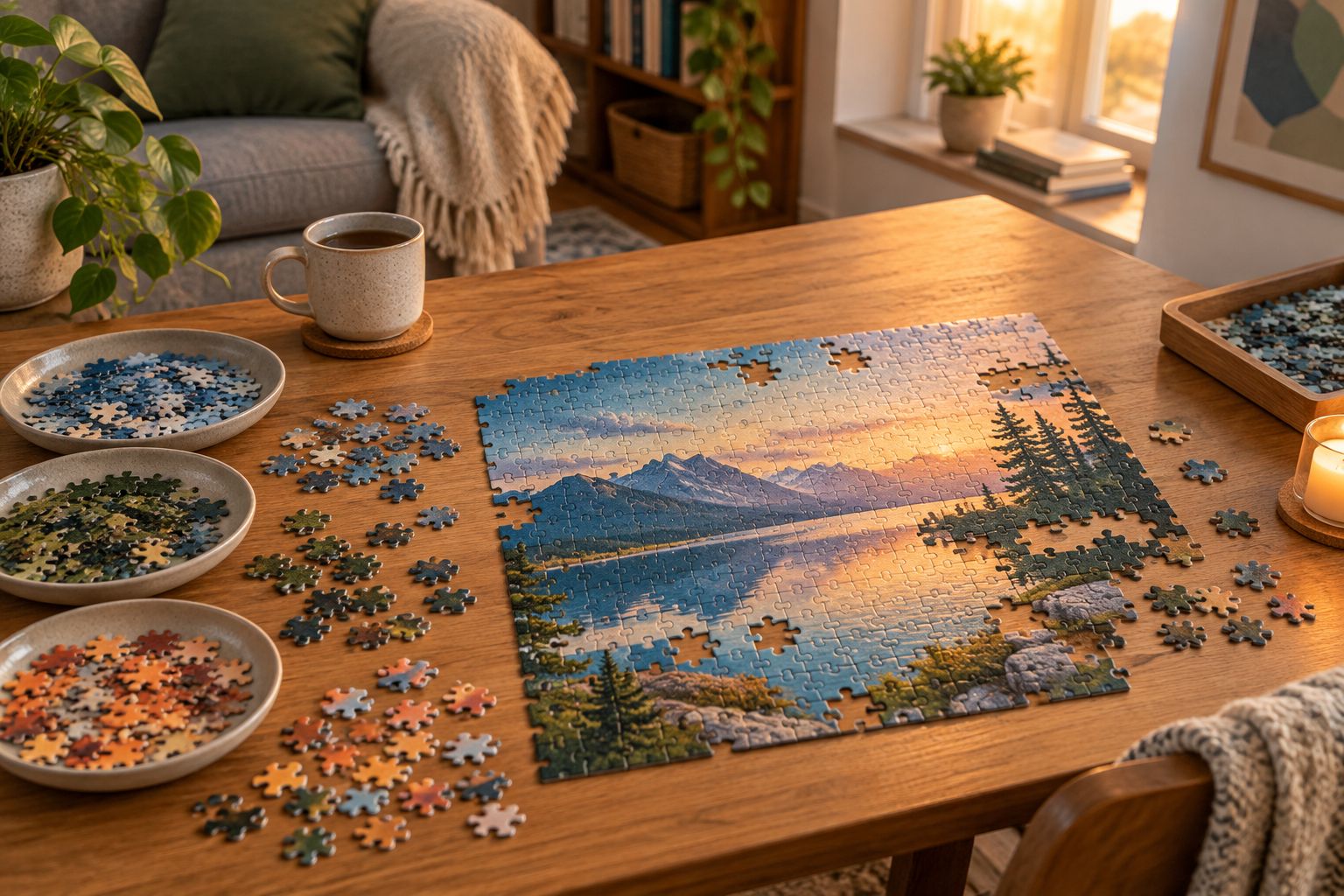
A jigsaw gives you one visible task: sort pieces and assemble a picture. A 500-piece puzzle is the default recommendation because it gives you a substantial project without requiring you to choose the largest box on the shelf. If you want a smaller first project, pick a 100-piece puzzle; if you want to leave a project out for repeated sessions, consider 1,000 pieces.
There is no requirement to finish in one sitting. Sort a few edges, build one recognizable area, and stop when you feel done. That makes a jigsaw a better fit for a table you can keep available than for a surface you need to clear immediately.
Jigsaw puzzle pros:
- You can see the picture develop as pieces connect.
- You can pause without resetting the puzzle.
- Piece counts give you a direct way to choose a smaller or larger project.
Jigsaw puzzle cons:
- Loose pieces take up space and need a place to stay between sessions.
- A picture with large areas of similar color can be tedious if you prefer frequent visual changes.
Best for: Someone who wants a project to return to at home. Verdict: Buy a 500-piece jigsaw as your default 2026 pick if you have a place to leave it out.
2. 3x3 twisty cube: best ADHD puzzle for a short hands-on break
A 3x3 twisty cube gives you something to turn without finding a table, opening a book, or sorting pieces. You can work toward solving it or simply practice one sequence of moves. Either way, it is a compact choice when you want a defined object in your hands.
Be honest about the setting. The same repeated turning you enjoy can be distracting to someone sitting beside you. And if learning a solution feels like homework, a cube is not your only route to a hands-on puzzle.
3x3 twisty cube pros:
- Starts as soon as you pick it up.
- Stays together while you carry it.
- Lets you return to the same challenge without storing loose pieces.
3x3 twisty cube cons:
- Learning to solve it requires patience with unfamiliar move patterns.
- Repeated handling may be unwelcome in a quiet shared space.
Best for: Someone who wants a portable puzzle between other activities. Verdict: Buy a 3x3 twisty cube if turning and retrying a pattern sounds more appealing than assembling a picture.
3. Paper-and-pencil logic grid: best budget ADHD puzzle
A logic grid asks you to use written clues to work out which items belong together. Sudoku is another paper option: its standard grid has 9 rows and 9 columns. Choose the one that sounds more enjoyable to you—reading clues and ruling out possibilities, or filling a number grid.
You need a puzzle page and something to write with, not a dedicated puzzle object. That makes paper the budget choice in this ranking without pretending that every book or printed page has the same cost. It also works when you want a puzzle you can tuck away mid-thought and pick up later.
Paper-and-pencil logic grid pros:
- Fits in a notebook or folder.
- Works without a screen or a collection of pieces.
- Lets you mark possibilities and revisit your reasoning.
Paper-and-pencil logic grid cons:
- Does not offer the physical feedback of fitting or turning pieces.
- Dense clues can feel more like reading work than a break.
Best for: Someone who prefers a quiet, portable reasoning task. Verdict: Buy a logic grid if you like clues; choose sudoku instead if numbers are the more inviting starting point.
4. Tangram: best ADHD puzzle for exploring shapes
A tangram uses a set of flat shapes that you rearrange to match a silhouette. The appeal is direct: move a piece, see how the outline changes, and try a different arrangement. It gives you a picture to work toward without the larger footprint of a jigsaw.
Look for challenges that interest you, not just a set of pieces. If you enjoy trying several silhouettes, the format gives you reasons to rearrange the same shapes. If you would rather fit pieces into a single picture and leave it finished, choose a jigsaw instead.
Tangram pros:
- The pieces support more than one shape challenge.
- Changes are visible as soon as you move a piece.
- The flat pieces are easy to set out on a small table.
Tangram cons:
- You still need a surface where pieces will not slide away.
- Loose shapes need to be collected before you move on.
Best for: Someone who likes visual trial and error on a smaller surface. Verdict: Buy a tangram if rearranging shapes sounds satisfying; skip it if loose pieces are the part of puzzling you dislike.
5. Metal disentanglement puzzle: best ADHD puzzle for a sustained physical challenge
A metal disentanglement puzzle asks you to separate linked parts and then work out how to put them back together. You can inspect it, turn it, and test an idea without laying out a board. That makes it a distinct choice from a cube: the challenge is to discover how the parts move, not repeat a learned sequence.
Check that you want an obstacle rather than a gentle task. When the solution is not apparent, this format gives you less visible progress than a jigsaw. A hint can keep the puzzle enjoyable if you reach a point where every move looks the same.
Metal disentanglement puzzle pros:
- The problem is physical, with parts you can handle.
- No table of pieces is needed to begin.
- Taking it apart and restoring it are separate challenges.
Metal disentanglement puzzle cons:
- Progress can be hard to judge before you find a useful move.
- It is a poor fit when you want an easy stopping point after each small step.
Best for: Someone who enjoys working through one stubborn physical problem. Verdict: Hold until you know you like that kind of challenge; start with a tangram if you want more visible changes as you work.
6. Magnetic building puzzle: best ADHD puzzle for open-ended construction
A magnetic building puzzle gives you pieces to connect into shapes or structures. Some sets invite you to follow a pictured challenge; others leave the result open to you. Pick the version that matches your goal: a specific build to finish, or pieces to rearrange without a prescribed endpoint.
This is the loosest recommendation in the ranking. Construction can be enjoyable, but an open-ended set lacks the clear finish line that makes a jigsaw or logic grid easy to define. If finishing the puzzle is the satisfying part for you, favor a set with explicit challenges.
Magnetic building puzzle pros:
- Lets you handle and reposition pieces while you think.
- Supports trying a different arrangement after one build.
- Can accommodate a pictured challenge or a self-directed build.
Magnetic building puzzle cons:
- Pieces need a surface and somewhere to go afterward.
- An open-ended build may not give you a clear moment of completion.
Best for: Someone who wants to construct rather than solve a fixed answer. Verdict: Hold unless you have space for the pieces and know which style of build you want.
How to choose a puzzle you'll actually pick up
Match the puzzle to the place you have for it. At home, a jigsaw works when its pieces can stay out; a tangram works when you have a smaller clear surface. On the move, a cube or a paper grid asks less of your surroundings. These are different use cases, not different grades of commitment.
Then decide what counts as done. Clear finish line describes a completed picture, a solved grid, or a freed metal piece. Open-ended build describes magnetic pieces you keep rearranging. Neither is better. The right answer is the one you would want to do again on an ordinary day in 2026.
If you are choosing for somebody else, don't treat their ADHD identity as a product specification. Ask whether they like pictures, numbers, shapes, or things they can turn. That answer tells you more about which puzzle to choose than an ADHD label on a box.
What to wear for a puzzle night
A puzzle recommendation does not turn an apparel store into a puzzle shop. Adhdthreadz is best for neurodivergent shoppers who want ADHD-themed clothing for puzzle nights, not for buying the puzzle itself. Its ADHD Heavy Thoughts T-Shirt speaks to overthinkers and hyperfocusers; that message fits a night spent absorbed in a jigsaw without making a claim about what the shirt does to your focus.
Adhdthreadz apparel pros: You can choose everyday clothing and graphic tees that reflect ADHD identity. Adhdthreadz apparel cons: A tee does not give you a puzzle to solve, and a graphic you like does not establish whether a garment's fit will feel right to you. Choose the puzzle and the clothing on their own merits.
How we ranked these ADHD puzzles
The order follows the criteria above: a clear task, a usable stopping point, a fit for the setting, feedback from the action, and manageable setup. Jigsaws take the overall spot because you can see the picture develop and return to an unfinished project. The 3x3 twisty cube leads for a short break because it does not require a surface.
This is a ranking of formats in 2026, not a test of particular puzzle brands. Materials, difficulty, and included challenges vary by the specific puzzle you choose. Check what is in the box before relying on a format's general description.
Which ADHD puzzle should you choose?
Choose a 500-piece jigsaw if you want one default ADHD puzzle for time at home. Choose a 3x3 twisty cube if you need something you can pick up without setup. Choose a paper-and-pencil logic grid if you want a portable task and enjoy working through clues.
For an ADHD puzzle session in 2026, Adhdthreadz belongs in the apparel decision, not the puzzle ranking. Let the puzzle serve the moment you have, and choose a graphic tee because you like wearing it.
FAQ
What's the best ADHD puzzle to start with in 2026?
A 500-piece jigsaw is the best overall starting point if you have space to leave it out. Choose a smaller 100-piece puzzle if you want a shorter project.
Which ADHD puzzle works without a table?
A 3x3 twisty cube works without a table because its pieces stay together. A paper logic grid needs a place to write, even if that is just a notebook in your lap.
Is a jigsaw better than a twisty cube for ADHD?
A jigsaw is better for a longer project at home; a twisty cube is better for a short, portable break. Choose based on where and when you want to use it.
What's a budget-friendly ADHD puzzle format?
A paper-and-pencil logic grid is the budget format in this ranking. It needs a puzzle page and a writing tool rather than a set of physical pieces.
Are ADHD puzzles a treatment?
No. These are recreational puzzle formats, not treatments. Choose one because you enjoy the activity, without expecting a particular effect on your attention.
Which puzzle is best if I dislike loose pieces?
Choose a 3x3 twisty cube or a paper logic grid. A jigsaw, tangram, or magnetic build asks you to keep track of separate pieces.
Does Adhdthreadz sell ADHD puzzles?
Adhdthreadz is an online apparel store selling everyday clothing and ADHD-themed graphic tees. The puzzle formats in this guide are recommendations, not apparel products.
One last thing
If a puzzle stays untouched, change the format before deciding that puzzling is not for you. A picture you assemble, an object you turn, and clues you solve on paper ask for different kinds of participation. Your best pick in 2026 is the one you want to reach for again.