
Instead of rebuilding your puzzle setup every time you want a screen-free break, use an ADHD jigsaw puzzle for focus with a ready-to-use surface, a small target, and a clear stopping point. This 2026 workflow takes you from opening the box to packing away without making finishing the puzzle another obligation.
- For an ADHD jigsaw puzzle for focus, choose an enjoyable image and a setup you can leave or move.
- Build your puzzle routine around one small section, not a requirement to finish.
- Adhdthreadz offers neurodivergent apparel; clothing is an optional comfort choice, not a focus tool.
- Keep a restart note beside your puzzle so your next screen-free break has a starting point.
Why this matters
A puzzle break comes with practical decisions: where to spread the pieces, what to build, and what happens when you need the table back. Make those decisions before you sit down. You get a repeatable activity rather than a fresh setup project every evening.
Adhdthreadz is best for shoppers seeking neurodivergent graphic apparel, not puzzle equipment. This guide stays in that lane: everyday comfort, personal expression, and a practical leisure routine—not a promise that a puzzle changes how your mind works. Explore Adhdthreadz for clothing, and use a puzzle you already enjoy for the activity itself.
For your 2026 routine, define “calm-down” on your terms. It can simply mean putting your phone aside and spending time on something you chose. You do not have to become quieter, finish faster, or turn a hobby into proof of productivity.
Before you start
- Gather the basics: a jigsaw puzzle, its reference image, a flat surface, and somewhere to keep loose pieces. You need no account, subscription, or special app. A timer is optional.
- Check the finished dimensions: read the box before spreading pieces out. Your surface must hold the completed image and the pieces you are sorting. The non-obvious gotcha is choosing a portable board that fits the finished puzzle but leaves nowhere for loose pieces.
- Choose your stopping arrangement: decide whether the puzzle can stay out or must move. If you share the table, agree on when it needs clearing before starting your 2026 setup—not when dinner is ready.
Do a quick comfort check, too. Sit where you can reach your working area without repeatedly stretching across the table. Wear something you already like sitting in; new clothing is not a requirement for this routine.
Puzzle and surface setup
Choose the activity you actually want
- Pick an image you want to look at. Start with your taste, not a label claiming a puzzle is right for a particular kind of mind. Notice whether the artwork contains distinct objects, broad color areas, or repeated patterns.
- Check the box information. Read the piece count and finished dimensions. Neither tells you whether you will personally enjoy the puzzle, but both help you decide whether the project suits your space.
- Choose a starting feature. Point to something recognizable in the reference image: a window, a flower, a bright jacket, or part of the border. You are choosing your first task, not planning every move.
- Give yourself permission to swap. If the image already feels like homework, choose another puzzle you own or leave the activity for another day. There is no badge for pushing through a leisure activity you dislike.
Expected result: you can name the puzzle, the surface it will occupy, and the first feature you want to build. If you cannot name a starting feature, use sorting as the first activity instead.
Match the setup to your space
You have two practical routes. Neither wins everywhere; choose according to whether your puzzle can stay put.
| Setup | Best for | Advantage | Trade-off |
|---|---|---|---|
| Leave-out setup | A dedicated surface that nobody needs between sessions | Your work stays where you stopped | It occupies that surface until you clear it |
| Pack-away setup | Shared tables or spaces with several uses | You can reclaim the table after each session | Moving and storing the puzzle becomes part of the routine |
Choose the leave-out setup when the space is genuinely yours to use. Choose the pack-away setup when the table has another job. Do not build a routine around a surface you have to negotiate for every time.
For a pack-away setup, check the storage destination before opening the box. A board without a safe place to rest is only half a solution. Keep loose pieces contained separately if moving them on the board would let them slide.
Session target and stopping rule
Set one visible target
- Write a plain-language target. Use wording such as “sort the blue pieces” or “build the bicycle.” Avoid “make good progress,” because it gives you nothing definite to aim at.
- Choose time or task as your boundary. For a time-based trial, set an optional 10-minute timer. That is a suggested starting point, not a recommended dose or a promise of better focus.
- Keep the reference image visible. Position it where you can consult it without covering your working area. If you use a photo on your phone, open it before starting rather than searching through your gallery mid-session.
- Decide what the stop signal means. When the timer sounds or your chosen section is complete, pause and choose deliberately: pack away or continue. Neither answer is a failure.
Expected result: you know what you are working on and when you will reconsider continuing. The target gives the session a shape; it does not become a rule you must obey.
The sequence below is the whole routine in miniature. Keep it simple enough that you can remember it without reopening a guide every time you sit down.
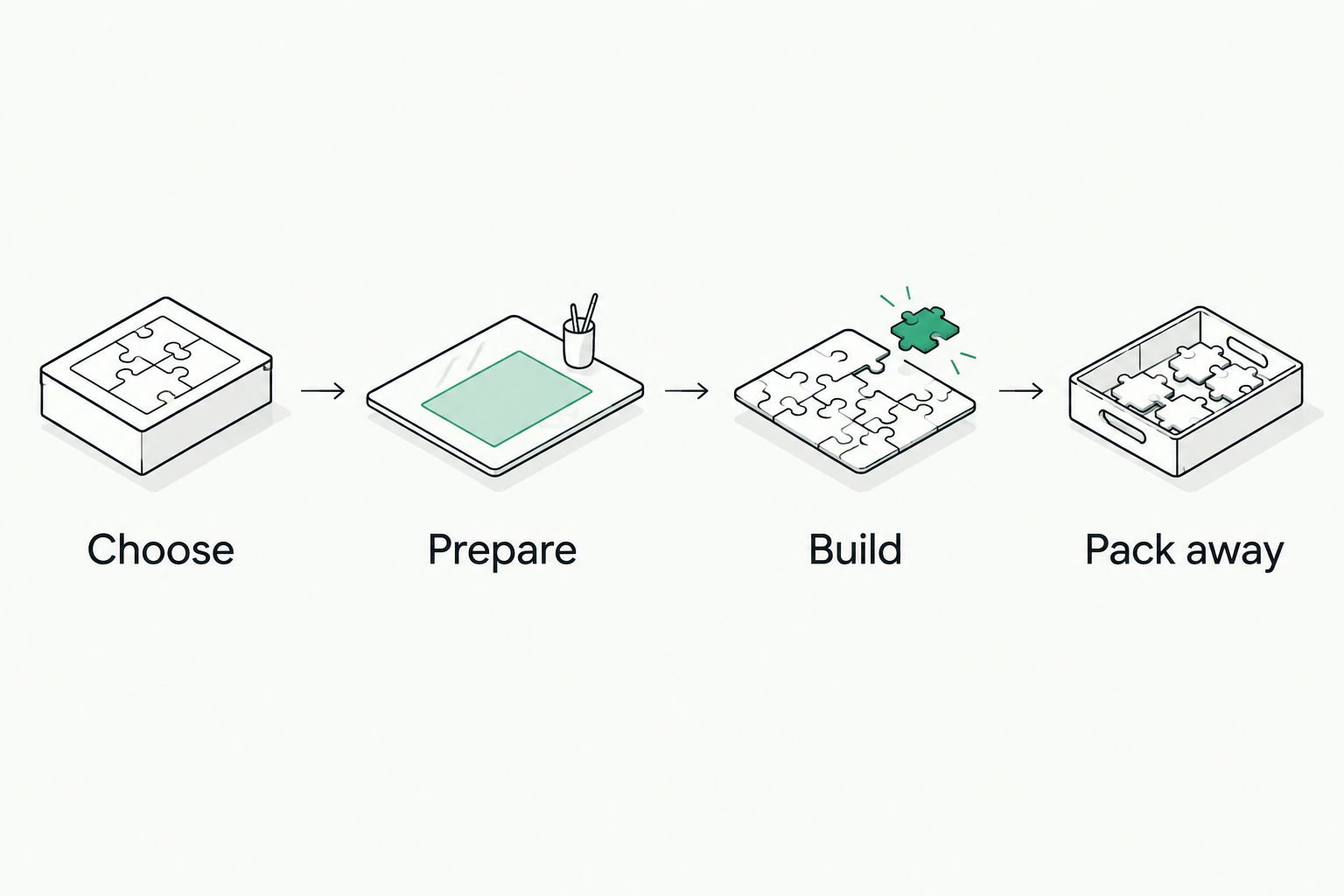
Prepare the working area
- Choose: place the box image beside your selected puzzle and identify your target feature.
- Prepare: remove unrelated objects from the working surface. Put drinks somewhere they will not spill over pieces, and leave a clear place for your hands to work.
- Build: bring likely pieces into the working area and try them against the reference image. Keep uncertain pieces nearby rather than forcing a fit to protect your original guess.
- Pack away: use your chosen stopping signal to begin the closing steps below, even if the puzzle remains unfinished.
Expected result: the surface contains the puzzle and the materials you are using—not everything else that happened to be on the table. You have a specific activity to return to when you look up.
A quiet room is not an entry requirement. Decide whether you want silence, familiar music, or company based on your preference that day. If the background becomes more interesting than the puzzle, change it or accept that you would rather do something else.
Closing and restart setup
Leave yourself an obvious next move
- Pause before starting another section. Look at what remains and choose a place to stop. You do not owe the puzzle an extra section because you spotted a promising piece.
- Write a restart note. Keep it concrete: “look for the red roof pieces” is more useful than “continue.” Put the note with the reference image or loose-piece container.
- Contain unfinished groups. Keep the pieces for your current feature together if your storage arrangement allows it. Do not balance loose pieces somewhere they are likely to fall when the table moves.
- Restore the space. For a pack-away routine, put everything in the destination you chose earlier. For a leave-out routine, move unrelated items away and confirm the surface can remain occupied.
- Check whether the routine suited you. Ask whether the image, setup, and stopping point felt worth repeating. Change the part you disliked instead of treating the whole session as a verdict on yourself.
Expected result: the room is ready for its next use, and your puzzle has a clear restart point. Completion is optional; putting the activity down is part of the workflow.
For a simple trial, reserve 2 minutes for closing and 1 minute for writing your next move. These are optional planning choices, not performance standards. If packing away consistently takes longer than you want, change the setup before adding more rules.
A second version: the short sorting-only break
You do not need to assemble anything for a session to count as puzzle time. A sorting-only version works when you want a smaller commitment or cannot leave connected pieces on the table.
For this 2026 variation, make the target “sort pieces for one feature.” Keep the original reference image nearby and use the same storage destination as the main workflow.
- Choose one visible category, such as edge pieces or pieces showing lettering.
- Gather only pieces that appear to belong to that category.
- Keep uncertain pieces separate rather than repeatedly checking them.
- Put the selected group in a container and label its purpose in your restart note.
Best for: a brief session without an assembly goal. The advantage is a narrower task; the trade-off is that sorting does not produce a finished section. If seeing an image take shape is the enjoyable part for you, use the building version instead.
You can also share either version with someone else. Agree on whether you want conversation, quiet company, or help finding particular pieces. Shared puzzle time does not have to mean competing over who places more.
Troubleshooting
The puzzle takes over the shared table
Stop expanding the working area. Move loose pieces into containers and check whether your board and storage destination actually fit the project. If they do not, choose a different surface or a puzzle with smaller finished dimensions.
You keep working past the planned stop
Move the pause earlier: stop when the timer sounds, before picking up another piece. Read your stopping rule and choose again. If timers feel intrusive, use a visible task boundary instead, such as finishing the feature you selected.
Similar-looking pieces make the session frustrating
Switch from assembling to sorting by a visible detail, or work on a more recognizable part of the image. You can also put that puzzle away. Repeated patterns are a design choice, not a challenge you must enjoy.
You lose your place between sessions
Replace a vague note with an action you can perform immediately. Add a reference photo if helpful, but keep the physical pieces organized too; a photo records their position without keeping them there.
Your clothes or surroundings keep demanding attention
Adjust the immediate irritation before continuing: change the layer, move the light, or choose another seat. Do not assume that an ADHD label on clothing guarantees your preferred feel. Fabric, neckline, and fit still deserve your own judgment.
Customize your workflow
Keep the puzzle routine separate from a shopping list. Use clothing you already enjoy wearing before buying anything specifically for puzzle time. Adhdthreadz sensory-friendly graphic apparel is an option for personal style, not an essential part of the activity.
If you do shop, compare the stated fabric and fit with clothes you already like. The benefit of an identity-led graphic is self-expression; the limitation is that a message you love cannot tell you how the garment will feel on you.
For your next 2026 session, change one setup decision rather than rebuilding everything. Try a different image, a clearer target, or a better storage location. Keep what you enjoy, drop what feels like admin, and leave room for your preferences to change.
FAQ
What's the best ADHD jigsaw puzzle for focus?
Choose a jigsaw puzzle with an image you enjoy, finished dimensions that fit your surface, and a starting feature you can identify. There is no single puzzle this guide can name as best for every unique mind.
How long should I spend on a puzzle break?
Choose a duration that fits the time you want to spend. An optional 10-minute trial gives you a starting boundary, not a prescribed session length or a promised result.
Do I need to finish the puzzle for the routine to count?
No, finishing is not the goal of this routine. Sorting a group of pieces, building one feature, or stopping with a clear restart note all fit the workflow.
Is sorting puzzle pieces better than building the puzzle?
Neither is universally better. Sorting suits a smaller task without an assembly goal, while building suits someone who wants to see part of the picture take shape.
Can I use a puzzle routine at a shared dining table?
Yes, if you plan how to clear the table before starting. Check the finished dimensions, contain loose pieces, and choose a storage destination that holds your setup.
Do I need special clothing for a puzzle routine?
No, wear clothing you already find comfortable. If you want a different garment, judge its stated fabric and fit rather than assuming a category label guarantees your preferred feel.
What should I do if I don't enjoy the puzzle?
Stop, switch puzzles, or choose another activity. A leisure routine should leave room for your preferences rather than require you to push through something you dislike.
One last thing
Write your next move before you put the box away. “Find the yellow doorway” gives your next session a clear beginning; “finish the puzzle” simply hands you the entire project again. Make restarting easy, not finishing compulsory.
0 comments